
Symbols

Structure
People have always built with proportion, rhythm and relationship.
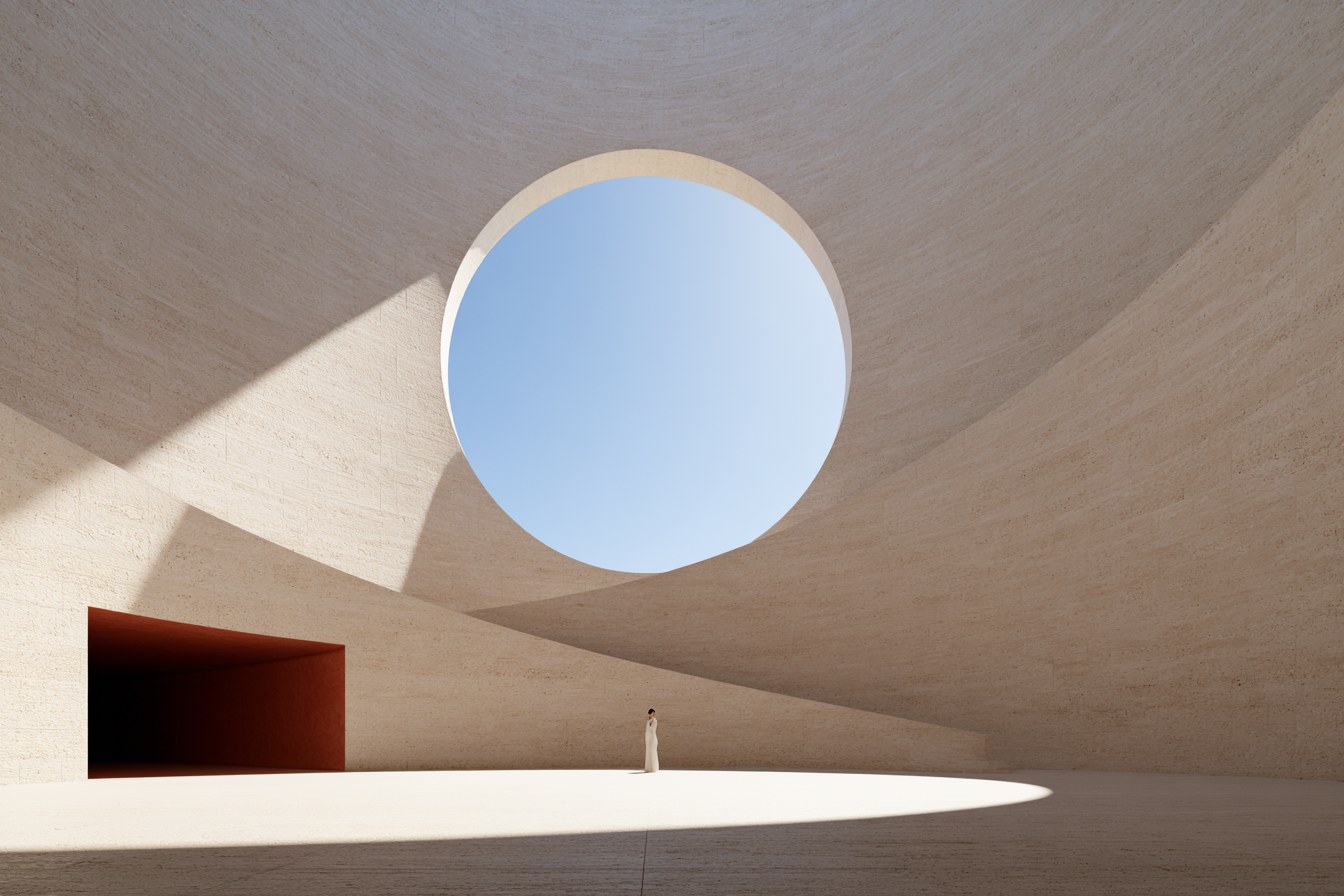
What am I seeing?
- What you can see
- A built interior with one circular opening high in the wall, and a single figure standing in the light it lets in. Everything in the room is arranged around that opening.
- Tradition
- Across centuries these relationships have taken form in temples, courtyards, observatories and places of gathering. Stone follows an axis. Openings gather around a center. Columns establish a pulse. Light completes what architecture begins.
- Coded Mind lens
- Symbols gather those relationships into forms we can return to. Their meaning is never contained in one explanation: it changes through culture, history, memory, and through the attention we bring to them.
- Coded Mind lens
- Repetition alters the encounter. As the hand follows the same structure again and again, the form becomes familiar enough for something less rehearsed to appear.
- Notice
- The photograph stands in for a building of this kind, not for any particular one.


In nature
We did not invent pattern.
We keep meeting it, and then we read it.
A flower, from above
What am I seeing?
- Coded Mind lens
- These are encounters, not evidence. Structure in a living system does not demonstrate intention, and finding a pattern in nature does not make a symbol true. Not every flower follows a formula, not every spiral is a golden spiral, and branching is never identical twice.
- Notice
- Before you bring the trace up, look at the form on its own for a moment. Notice what you saw first, and whether the measurement agrees with it.
The structure is in the world.
The reading is the part we bring.
We are drawn to harmony
before we understand it.
A monochord. One string, and one of the oldest instruments for measuring music.
Stop it exactly halfway and it sounds the same note, higher. That relationship is 2 : 1.
1 : 1 The whole string
Move along the string
The monochord
- What you can see
- One string, and the places along it where it can be divided. The marks are relationships between lengths: half the string, two thirds of it, three quarters of it, not points chosen for how they look.
- The pattern
- Changing where the string is divided changes how it can move. A node is a quieter point where the movement settles; either side of it the string swings freely. Move the division and the nodes move with it.
- Coded Mind lens
- Harmony here means distinct parts relating within one whole. It is a compositional idea, not a physical or psychological one: nothing on this page claims that a particular interval produces a particular effect in anybody.
- Notice
- With sound off, the string still answers: the shape it takes is the same either way. Sound is an addition, never the thing itself.
A vibrating string moves back and forth at a steady rate.
Stop it halfway and the shorter piece moves twice as fast.
That is all a proportion is here. Two speeds.
The dots turn at those two speeds, so one full turn is one full vibration: the same timing, drawn instead of heard.
Two against one comes back to the same place, over and over.
Three against two takes longer to come back. It still comes back.
The golden section never does: 1.618 cannot be written as one whole number over another, so the two never return to the same arrangement twice.
Some relationships come round again. Some never do.
Whether that is beautiful is not ours to say.
A circle returning to itself.
A rhythm held and repeated.
A proportion that allows every part to belong to something larger.
Order creates harmony.Harmony is not perfection.
It is the moment when difference begins to belong.
Vibration
Rhythm can make structure visible.
Mode 2 · 3
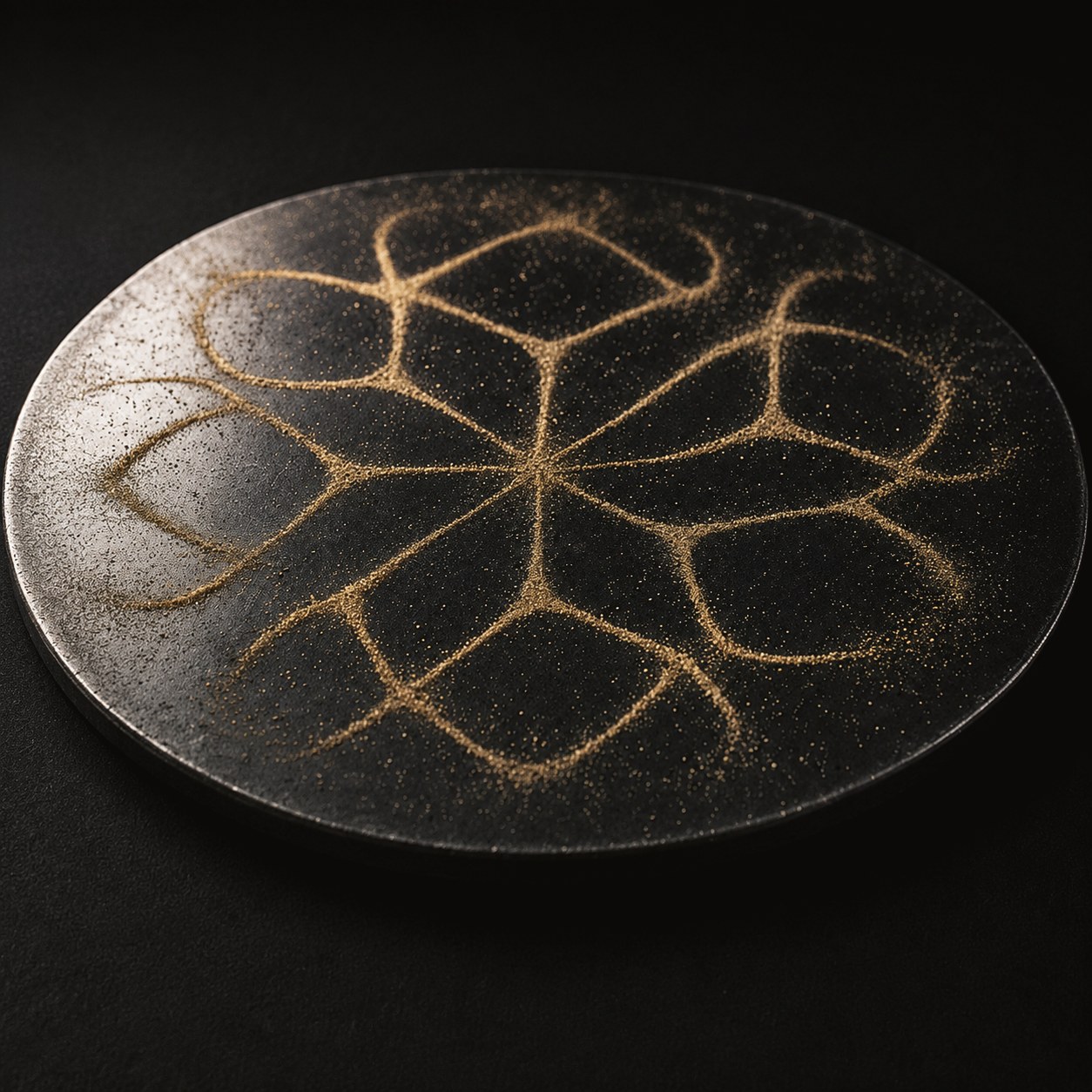
A simulated Chladni plate. Each pattern has its own note, and the pitches here are in proportion to one another.
Chladni's plates
- What you can see
- Fine grains on a vibrating surface. They are shaken away from the parts that move most, and they collect along the lines that barely move at all. Those quiet lines are the pattern.
- Where it comes from
- Robert Hooke saw it first, on 8 July 1680, drawing a bow along the edge of a glass plate dusted with flour. A century later Ernst Chladni made it a method: a violin bow on a metal plate scattered with sand, published in 1787 as Discoveries in the Theory of Sound. The 1787 figures
- Napoleon's prize
- In 1808 Chladni demonstrated the plates in Paris with Napoleon watching, and Napoleon offered a prize to anyone who could explain them mathematically. Sophie Germain entered three times (an honorable mention in 1813) and won on 8 January 1816, the first woman to win a prize from the Paris Academy of Sciences. She did not come to the ceremony.

What you see depends
on where you are standing.
Move until the fragments meet.
Registration 0%
Three planes, one construction
- What you can see
- Three separate drawings, each at a different distance from you. A circle, a cross, and a rectangle with one marked edge.
- The pattern
- They are parts of one figure, but only from one viewpoint. Move, and they slide past each other at different rates because they are at different depths. From almost everywhere they are three unrelated things; from one place they are a single construction.
- Coded Mind lens
- Nothing here changes shape. What changes is where you are standing, and that is enough to make the same three things read as one thing or as three.
- Notice
- If moving is not how you would like to do this, Align the planes does it for you. The arrow keys also move the viewpoint, one step at a time.
Seeing
You are looking at an eye.
or
Is an eye looking at you?
Close your eyes.
Picture an apple.
It was red, or green, or yellow.

Almost nobody pictures blue.
It is still an apple.
About 1 in 111 people cannot picture an apple at all.
About 1 in 16 see one as vividly as real sight.
Source / Lens
- Measured
- In the largest study of its kind, 9,063 people, about 0.9% could not form a voluntary visual image and about 6.1% reported images as vivid as real sight. Measured with the Vividness of Visual Imagery Questionnaire, Marks, 1973. Wright et al., Frontiers in Psychology, 2024
- Measured
- The absence was named aphantasia by Adam Zeman in 2015. Francis Galton first documented the difference in 1880, by asking colleagues to picture their breakfast table.
- Coded Mind lens
- This chapter shows you a difference that exists between people. It does not measure yours. Nothing here is recorded, scored or compared, and picturing nothing is not a failure of the exercise.
- Notice
- Whether the apple you pictured had a stem, a colour, a position in space. Most people do not notice what their imagining leaves out until they look for it.
Color
Visible light can be measured.
Color is experienced through perception, context and relationship.
Vermilion lightness 50 · saturation 50
Move across the field
Source / Lens
- Measured
- Light can be described by its spectral power distribution and specified numerically. The international standard for how those specifications are made is CIE colorimetry. CIE, Colorimetry, 4th edition
- Measured
- A color's appearance depends on the field around it. The two squares in this chapter are one identical pigment. What changes when a second color enters is the ground, not the square.
- Coded Mind lens
- Each color here has been given a movement and a grain of its own. Those are artistic decisions made for this chapter. They are not simulations of any color's physical frequency, and no color here is claimed to act on the body.
- Coded Mind lens
- These seven are a sequence chosen for this chapter, not seven universal categories, not healing frequencies, and not a set anyone is required to work through. Harmony, here, means a relationship a person finds agreeable. It is compositional, not physical.
- Notice
- Move slowly, then bring the second color in. Notice whether the square changed, or only what was around it.
Harmony is not held by one color.
It happens between them.
The relationship, kept
Explorations
Each Exploration begins with a symbol. We enter through its history, structure, rhythm and form, then draw it, respond through color, and keep what we make.
One openSix in preparation
The program
- What you can see
- Seven places in one field. One of them is open: the Sri Yantra, the First Exploration. The others are marked and not yet built.
- Coded Mind lens
- An Exploration is a way of meeting one symbolic structure closely enough that something of your own comes back out of it. The method is the same each time; the structure it is applied to is what changes.
- Proposed
- Future Explorations will work with other symbolic structures. Which ones, and in what order, is not decided: nothing is being promised here.
Coded Mind is one world. The symbols are ways in.
Before the first Exploration
A structure precise enough to be read,
and open enough that the reading is yours.
The First Exploration is next
Source / Lens
- Tradition
- The Sri Yantra belongs to living Śrīvidyā traditions, where it is used in practice and taught within lineages. It is not a decorative motif, and it is not ours to explain on anyone's behalf.
- Tradition
- Its construction brings together an outer enclosure, lotus rings, interlocking triangles and a central point, the Bindu. Those names are used within the traditions that hold it.
- Tradition
- Interpretations vary across texts, teachers and lineages. There is no single reading that holds for all of them, and Coded Mind does not present one reading as the reading.
- Coded Mind lens
- Coded Mind approaches it as both inherited structure and contemporary encounter, with attention rather than claim. Nothing here is offered as a healing property or a cosmic effect.
- Notice
- What is drawn on this page is a schematic of the principle of the construction, not a reproduction of the figure you are about to meet.
Breath
Before you create,
make an interval.
One minute. Nothing to achieve.
Not started
Six breaths
Breathe in gently. Let the breath leave without forcing it.
The interval
- Coded Mind lens
- Creativity does not always arrive by pushing harder. Sometimes it appears when the field around a question becomes wider. A pause can loosen the shape of a familiar problem.
- What you can see
- A circle that widens for four seconds and settles for six, six times over. The six marks on the perimeter fill as the cycles complete. That is the whole of it: there is nothing to get right.
- Research suggests
- Breathing changes heart rate across the respiratory cycle, and slow-paced breathing has been studied for its effects on heart-rate variability. Responses and preferred pacing differ considerably between people. Review and meta-analysis, PubMed 35623448
- Notice
- This is an interval, not a treatment. It is not offered to calm you, to produce insight, or to change anything about you, and nothing here is measured or scored. Ordinary breathing is always fine, and you can stop at any moment. If following the pace is uncomfortable, breathe as you normally would and simply watch the circle.
The First Exploration
Sri Yantra
or keep scrolling









Sri Yantra · the structure
A structure precise enough to be read,
and open enough that the reading is yours.
Tradition
Śrīvidyā and the Sri Yantra
- Tradition
- Śrīvidyā is a living tradition, taught within lineages and practised today. The Sri Yantra is the geometric structure that tradition holds, and it has deep historical and cultural roots. It is not a decorative motif, and it is not ours to explain on anyone's behalf.
- Tradition
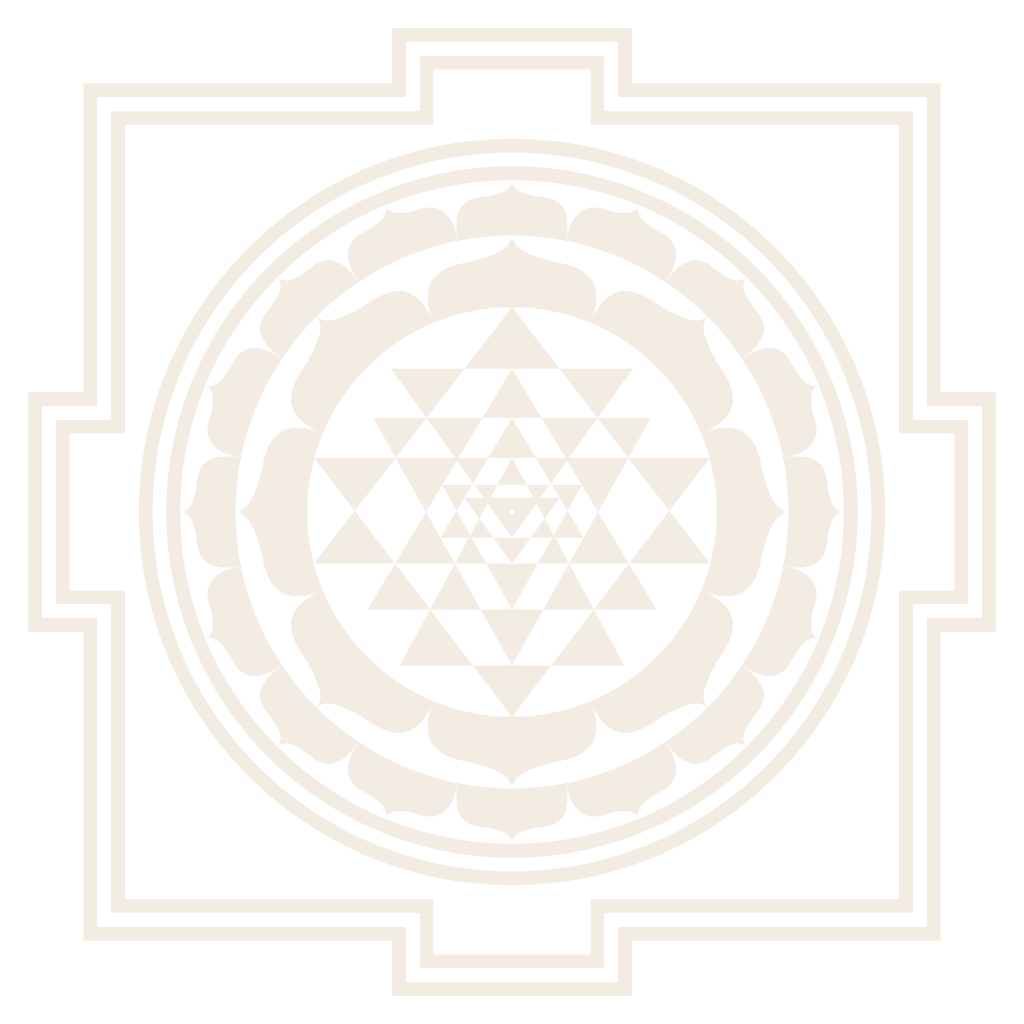
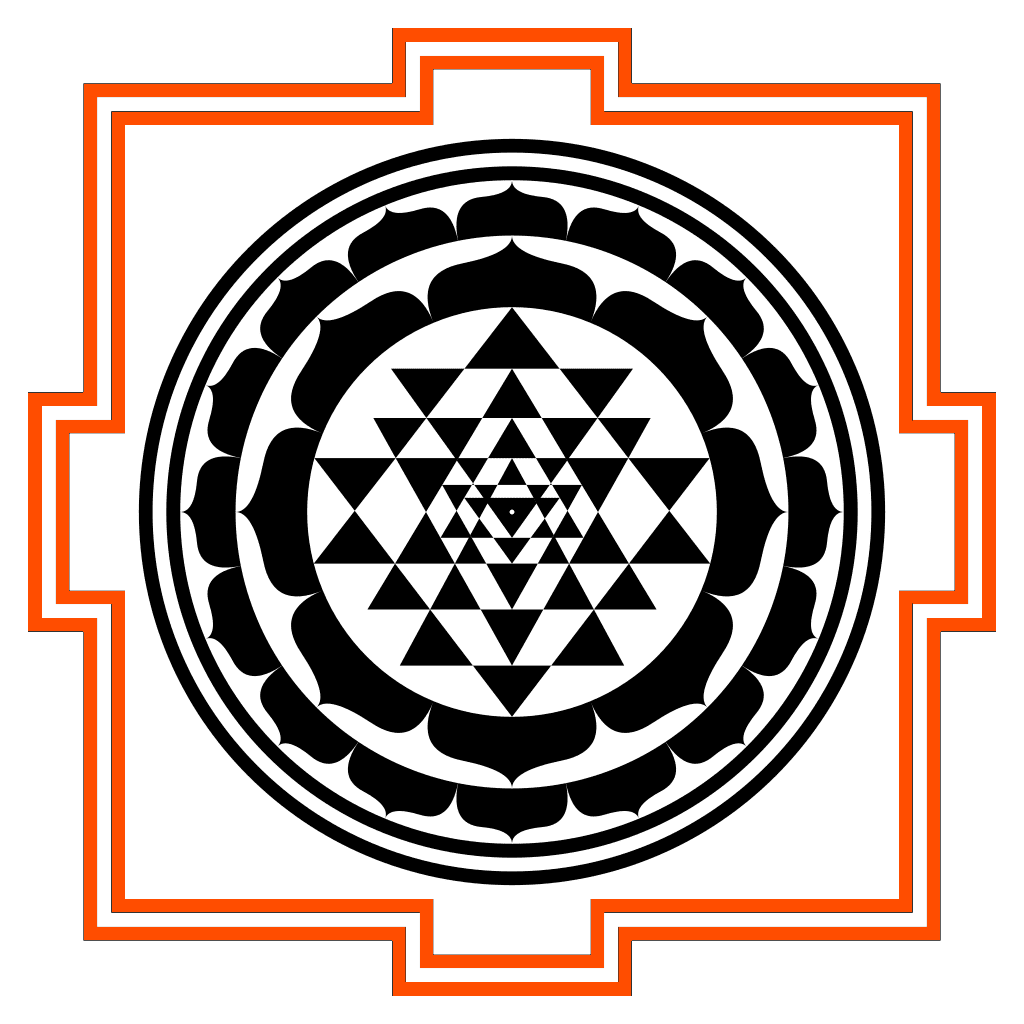
- Its visible construction brings together an outer enclosure, rings of lotus petals, a field of interlocking triangles and a central point, the Bindu. Those names are used within the traditions that hold it.
- Tradition
- Interpretations vary across texts, teachers and lineages. There is no single reading that holds for all of them, and Coded Mind does not present one reading as the reading.
- Coded Mind lens
- Coded Mind approaches it as inherited structure and as contemporary encounter, with attention rather than claim. It was chosen as the First Exploration for its extraordinary combination of complexity, balance, beauty and inward progression. Its ordered complexity invites sustained attention.
- Notice
- Nothing here is offered as a healing property, a cosmic effect, or a diagnosis. No claim is made that looking at this figure changes anybody's physiology.
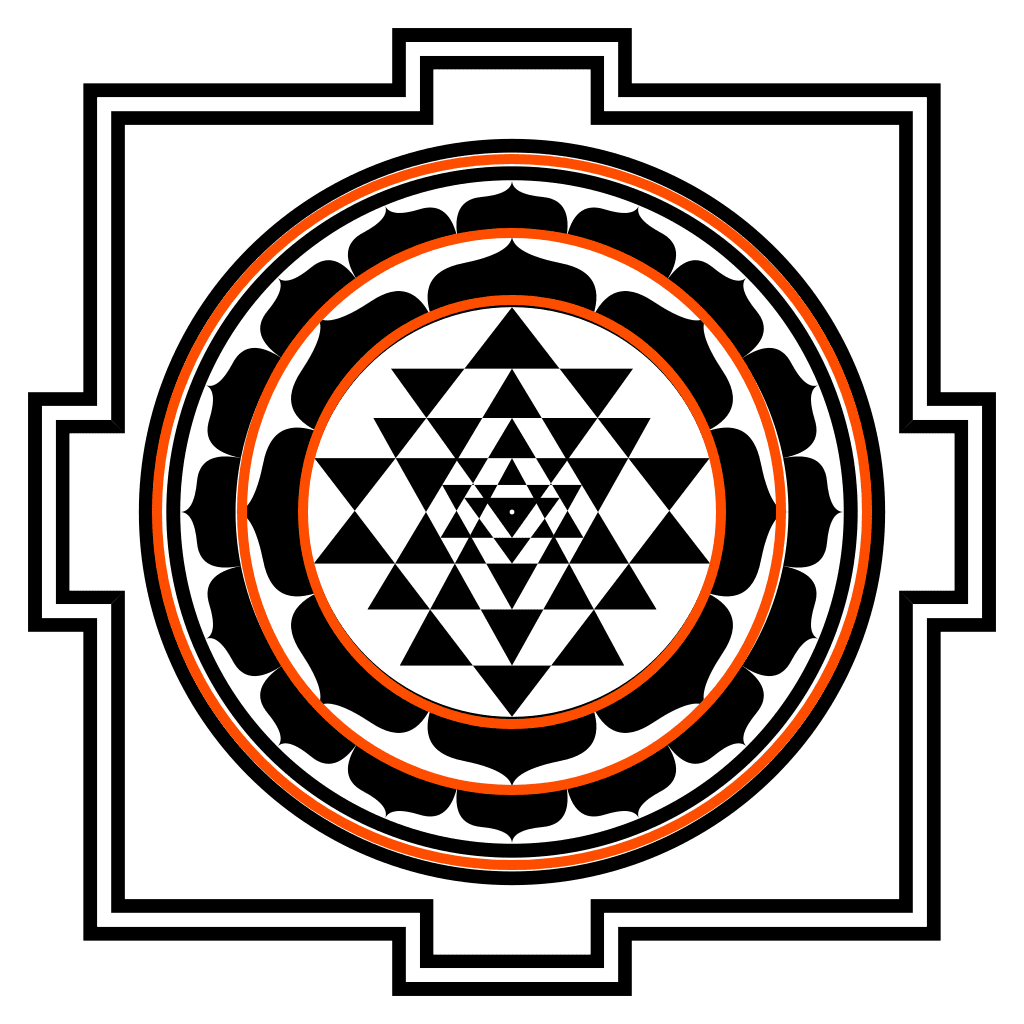
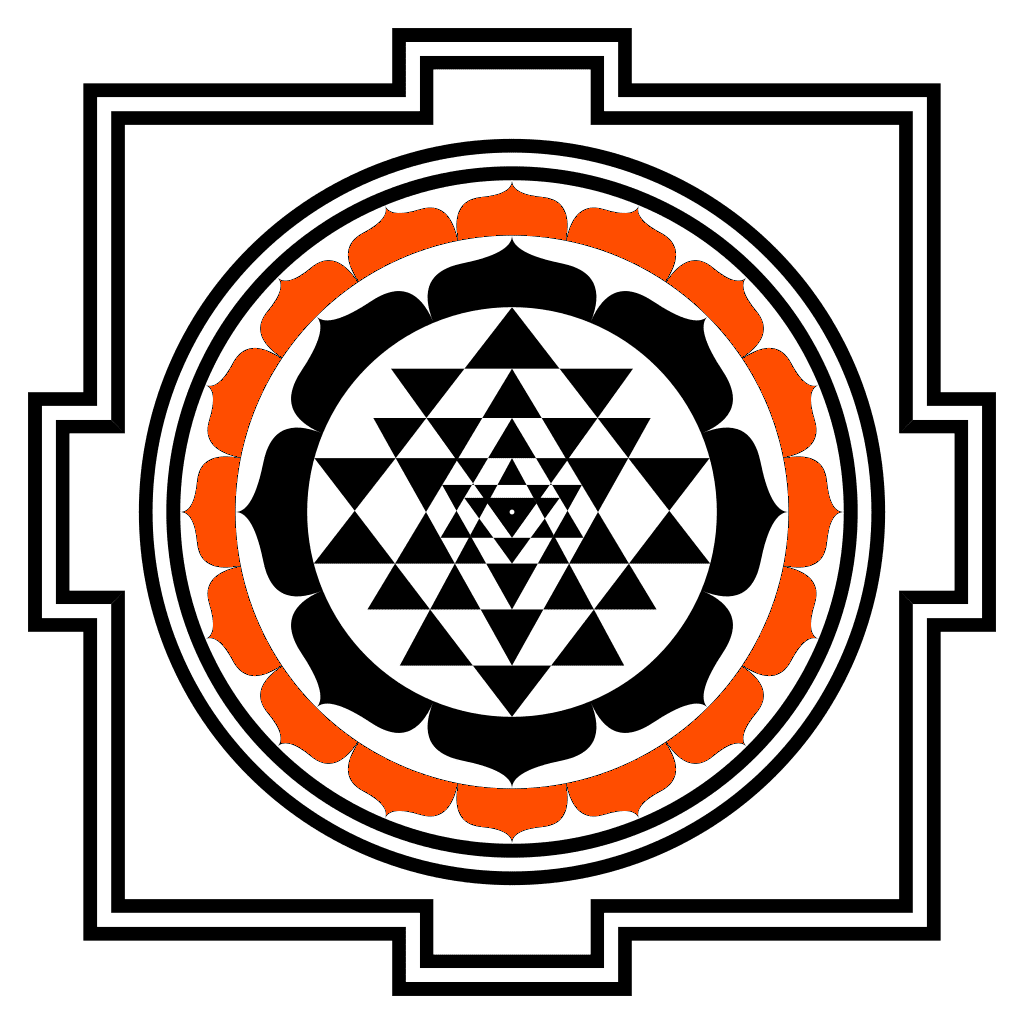
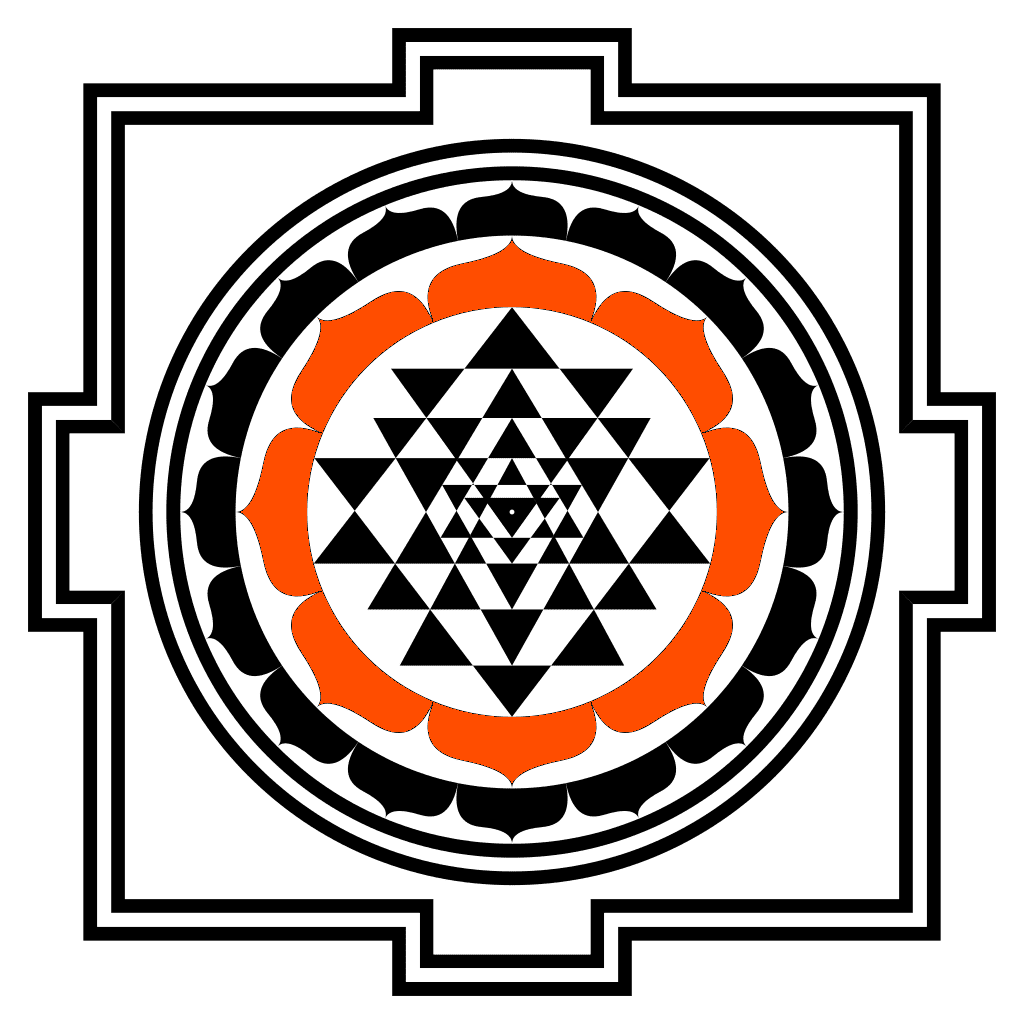
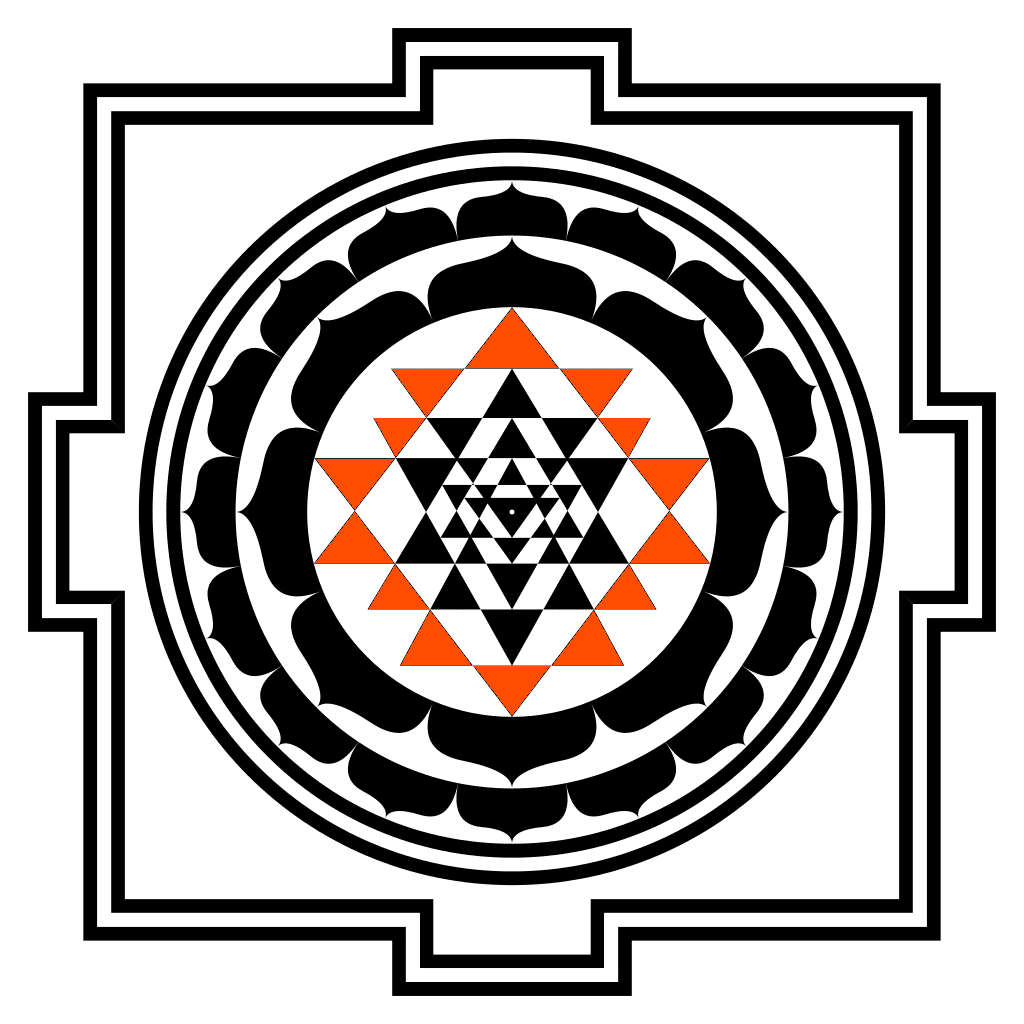
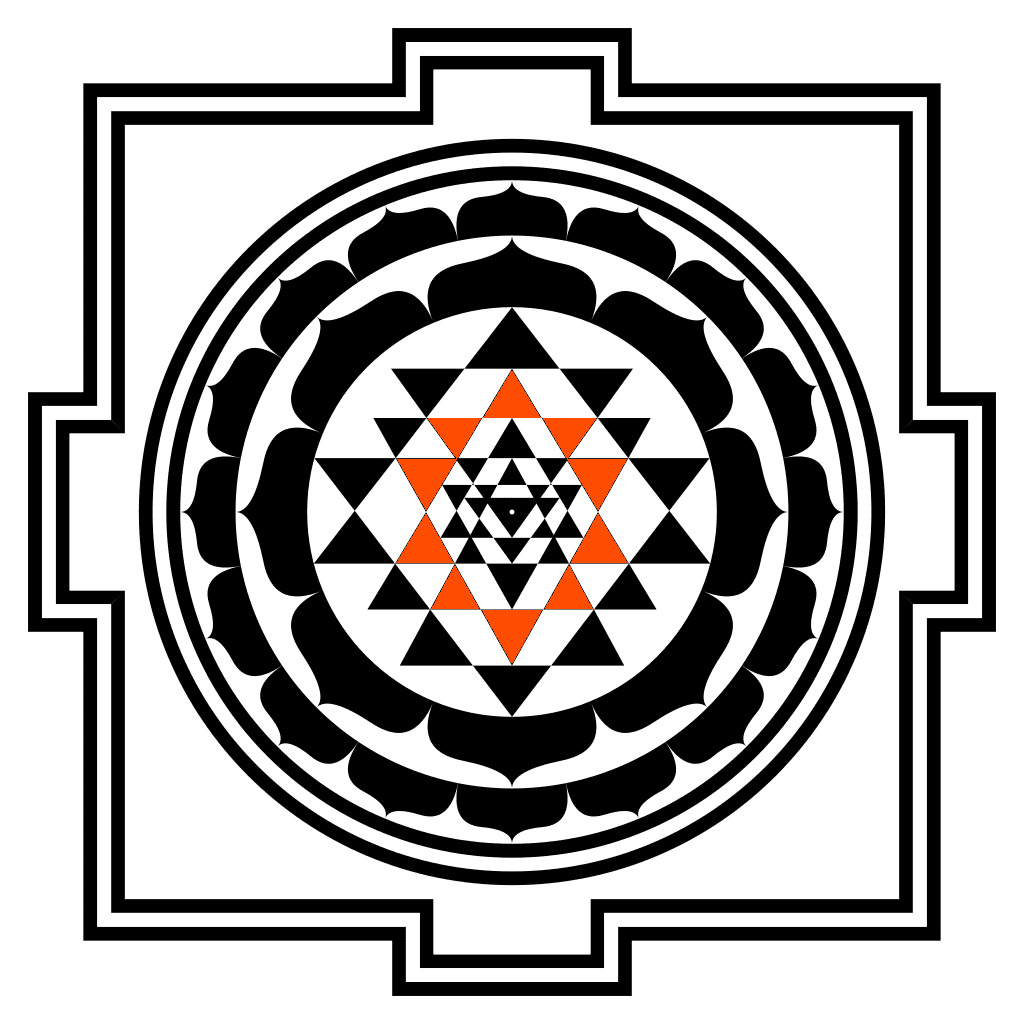
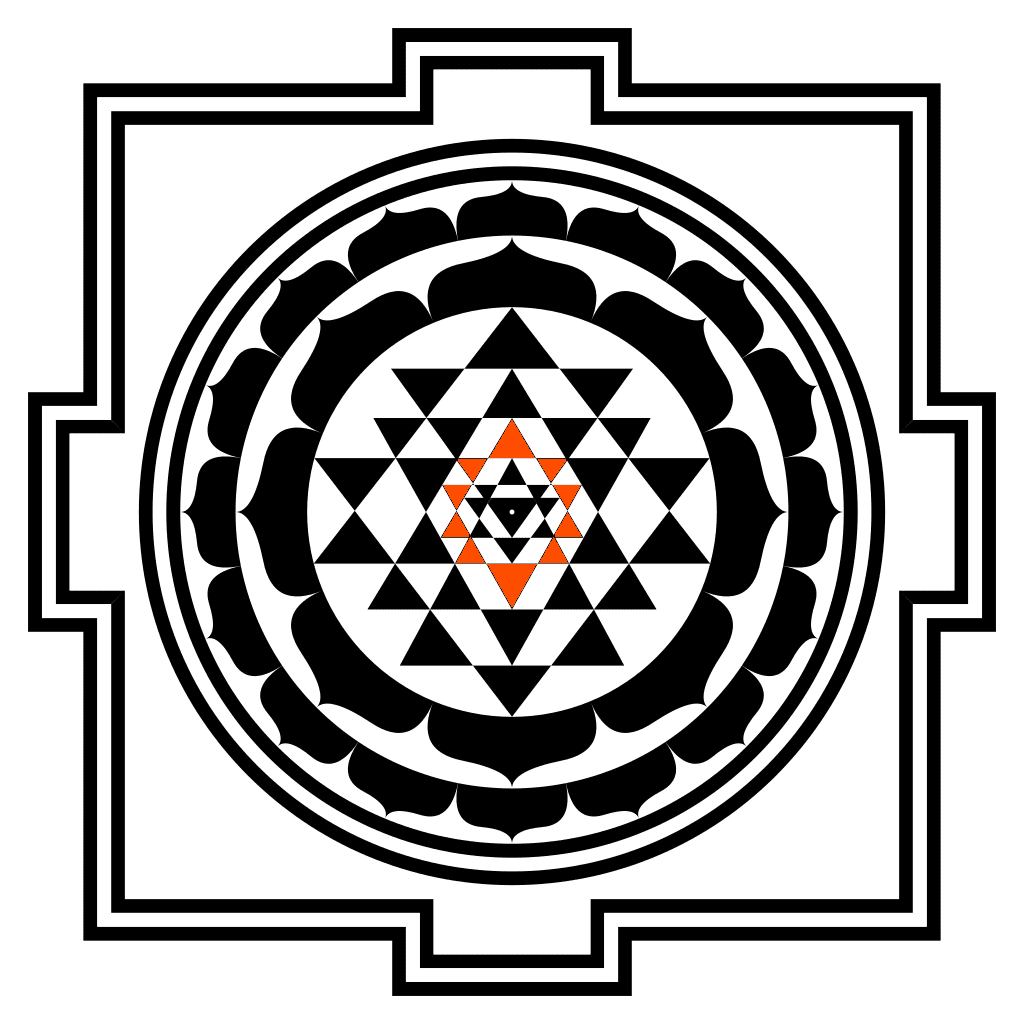
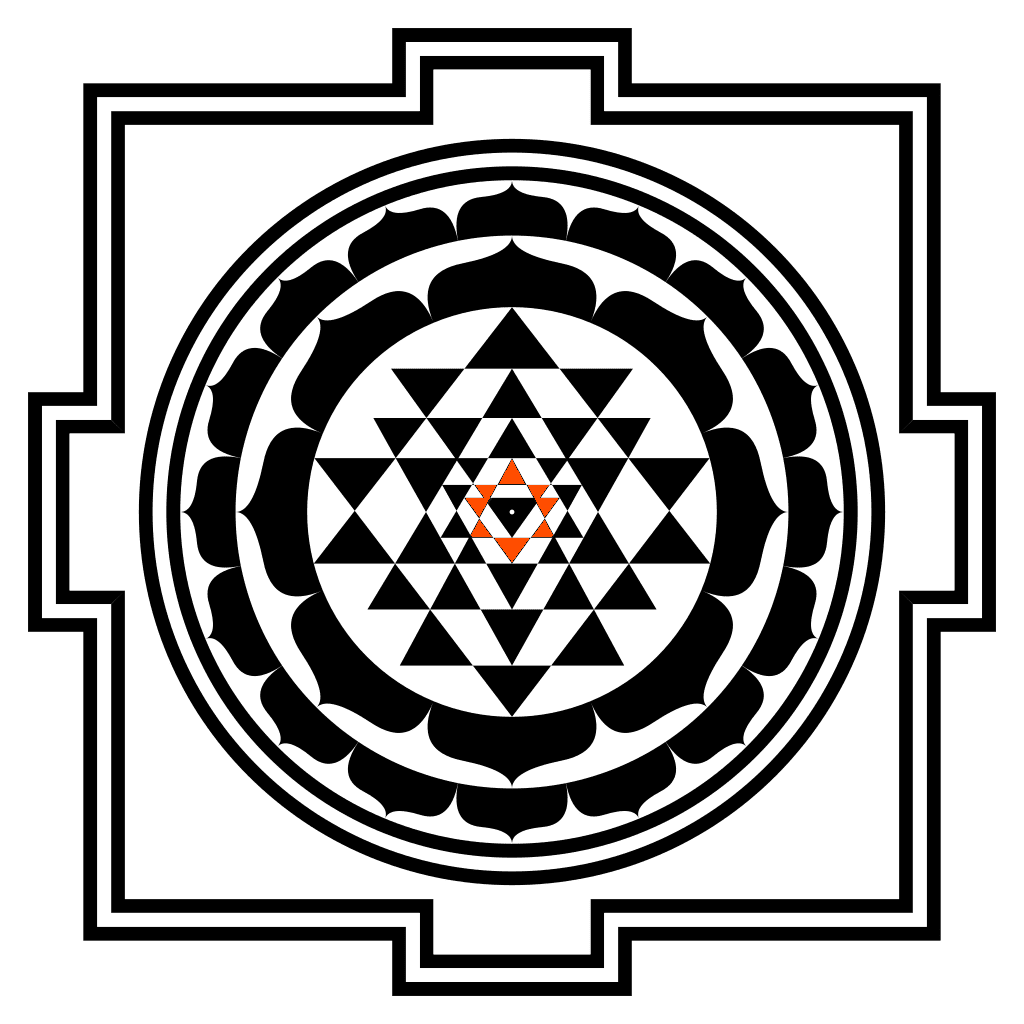
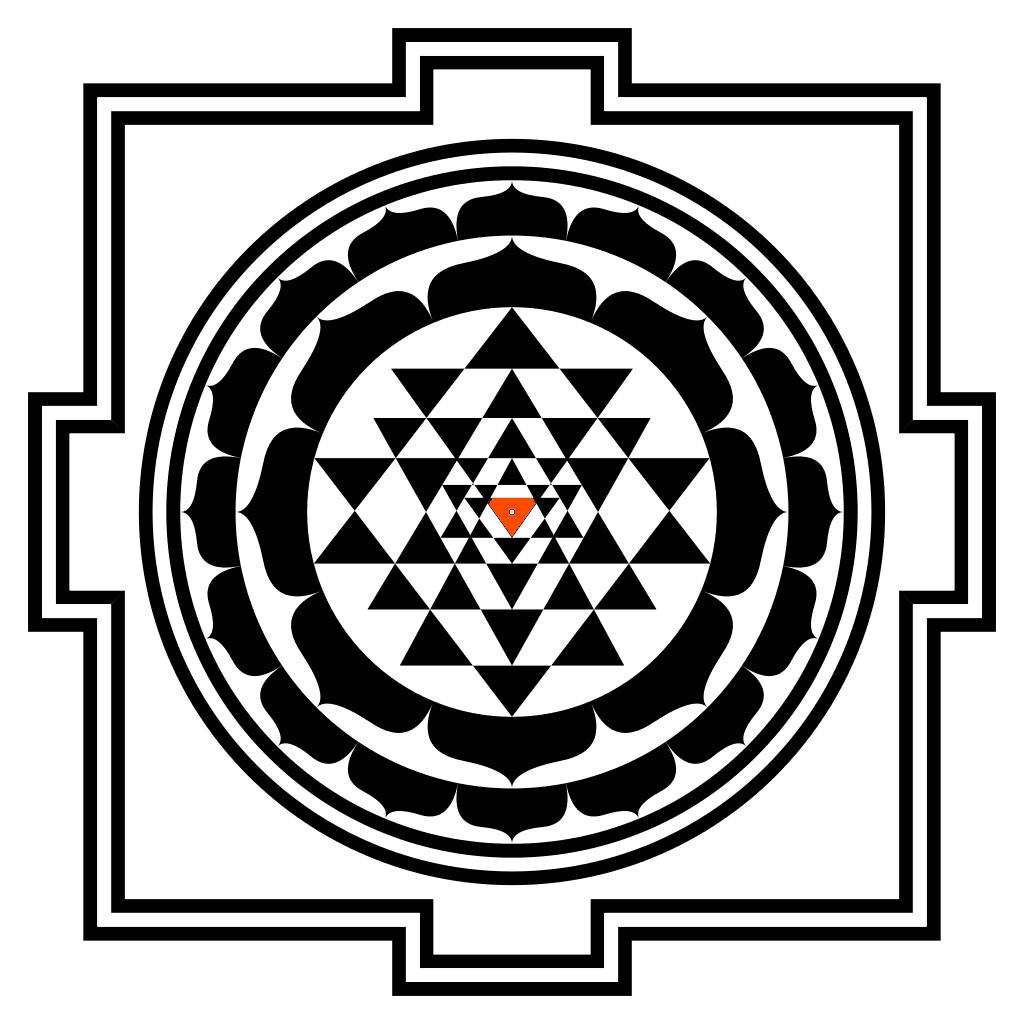
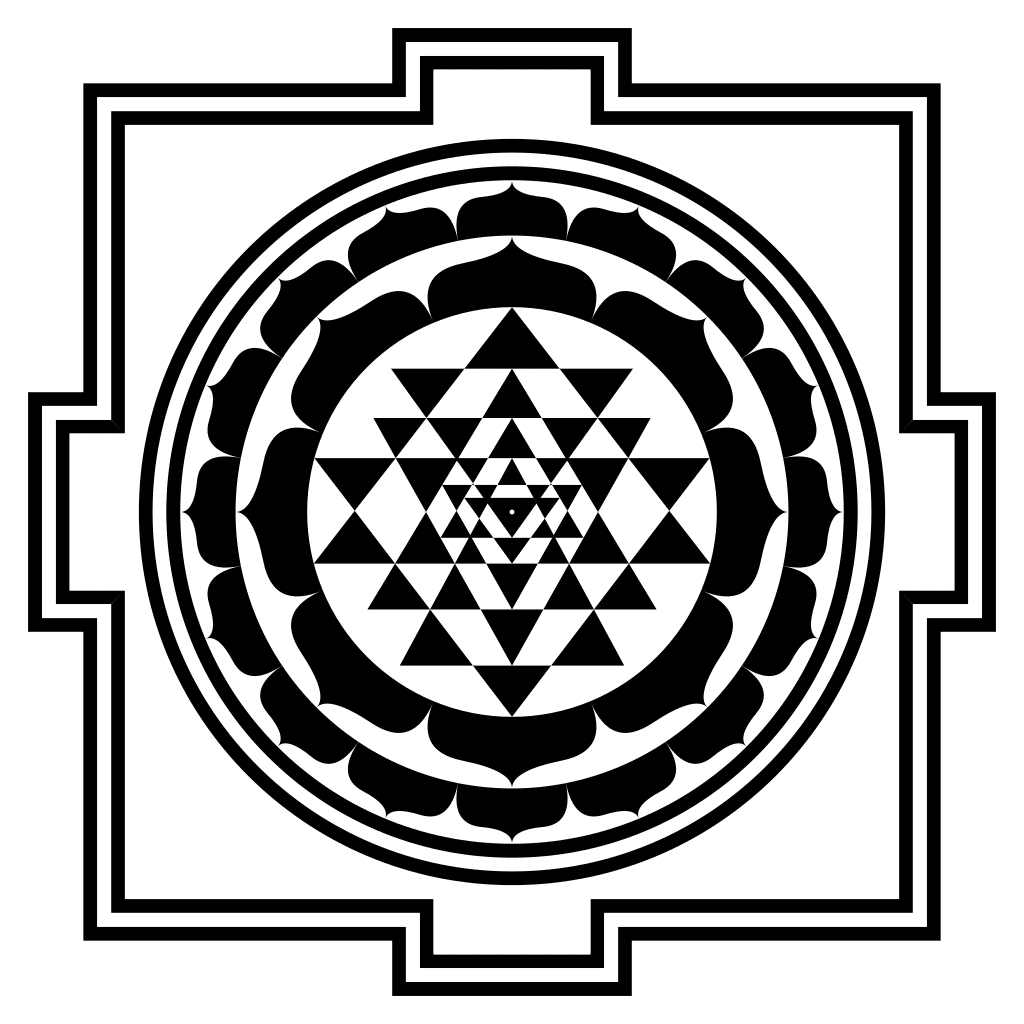
The First Exploration · Sri Yantra
Bhupura, the outer square
Choose a layer.
The layer
- Tradition
- These names are used within the living Śrīvidyā traditions that hold this figure. Interpretations of every part of it vary across texts, teachers and lineages: what is written here is a plain description, not a teaching.
- Notice
- No layer here is offered as a healing property, a planetary correspondence or a diagnosis. Coded Mind meets this figure as inherited structure and as a contemporary encounter.
How an Exploration works

Respond
You answer through color, drawing, mark or choice.
Making a mark gives thought another language.
Four seconds.
Long enough to notice a color. Not long enough to build a convincing explanation for choosing it.
Not started.
The first response is recorded without correction. Not because it is more true, but because it belongs to the moment before presentation takes over.
Rhythm
A disturbance settles into a rhythm. A rhythm repeats. Two rhythms, left alone, will sometimes drift toward each other.
Not running.
The rhythm
- What you can see
- A line that starts as a disturbance and settles into a rhythm, and a second line at its own pace beside it. Left running, the two drift toward each other. They never lock, because that would be a claim.
- The pattern
- The line is a traveling wave whose amplitude falls as it moves: the same relation the string uses in Harmony and the plate uses in Vibration.
- Notice
- This is optional. Ordinary breathing is always fine, there is no correct pace, and you can stop at any moment. Nothing here is counted, measured or scored.
- Research suggests
- Breathing changes heart rate across the respiratory cycle. Studies of slow-paced breathing examine effects including heart-rate variability, but responses and preferred pacing differ between people. Systematic review, PubMed 30245619 Review and meta-analysis, PubMed 35623448
- Coded Mind lens
- What is on screen is a visual rhythm, not a physiological instruction. It does not stimulate a nerve, guarantee a settled state, regulate a nervous system, or treat a condition, and it will not produce the same thing in everyone.
- Notice
- If following the line becomes effortful, stop following it. Watching is enough, and leaving is enough.
Coded Mind does not give you the answer.
It creates conditions in which another kind of answer may become visible.
It creates a pause in which you can notice another response, association or way of seeing the question.
Held tight
A creative and reflective practice. Not medical or psychological treatment.
What is this based on?
- Research suggests
- Setting a problem aside for a period has been associated with improved performance on some creative tasks. The pooled effect is modest and varies considerably with the task and the length of the pause. Meta-analysis of incubation effects
- Research suggests
- One small study measured lower salivary cortisol in adults after a short period of art-making. It is a single study with a small sample, not a general result about art and stress. Art-making and cortisol, small study
- Research suggests
- Slow-paced breathing has been studied for its effects on heart-rate variability, with responses and preferred pacing differing between people. Review and meta-analysis, PubMed 35623448
- Coded Mind lens
- Everything else on this page is what the practice may support in our experience of running it. It is an interpretation, not a finding: it is not a promise, and it will not be the same for everyone.
- Notice
- Coded Mind is a creative and reflective practice. It is not medical or psychological treatment, it does not diagnose anything, and it is not a substitute for care.
Between Explorations
What came forward first?
One sheet · nothing is saved
Moment 1 of 3
Let your eyes rest for a moment. Bring to mind a place you have liked being: the first that comes.
Take the moment first. Then answer.
This describes what came forward in this moment. It is not a fixed type, and it is not a test of who you are.
What this is
- What you can see
- One sheet, and four ways of answering drawn in the language of the chapters you have just been through: a color field, a rhythm line, a drawn mark, a written line. Whichever you choose leaves its own mark on the sheet.
- Coded Mind lens
- The question is what arrived first in one particular moment, not what you are usually like. Ask it again on another day and it may well answer differently. That is the point of asking it.
- Notice
- This is not a learning-styles test. There is no good evidence that people have fixed sensory learning types, and nothing here assigns you one. No result is scored, compared or kept.
- Notice
- Nothing you do here leaves your browser. The sheet is held in the page's memory only: reload it, or close it, and the sheet is blank again.
Still being made
The same structure.
No two journeys through it alike.
Coming next: Making, Thinking is only one way of knowing, Keep what you make, Why the method works, Founder, Editions, Journal, and Online and In Person.